Wire · Echonomia Post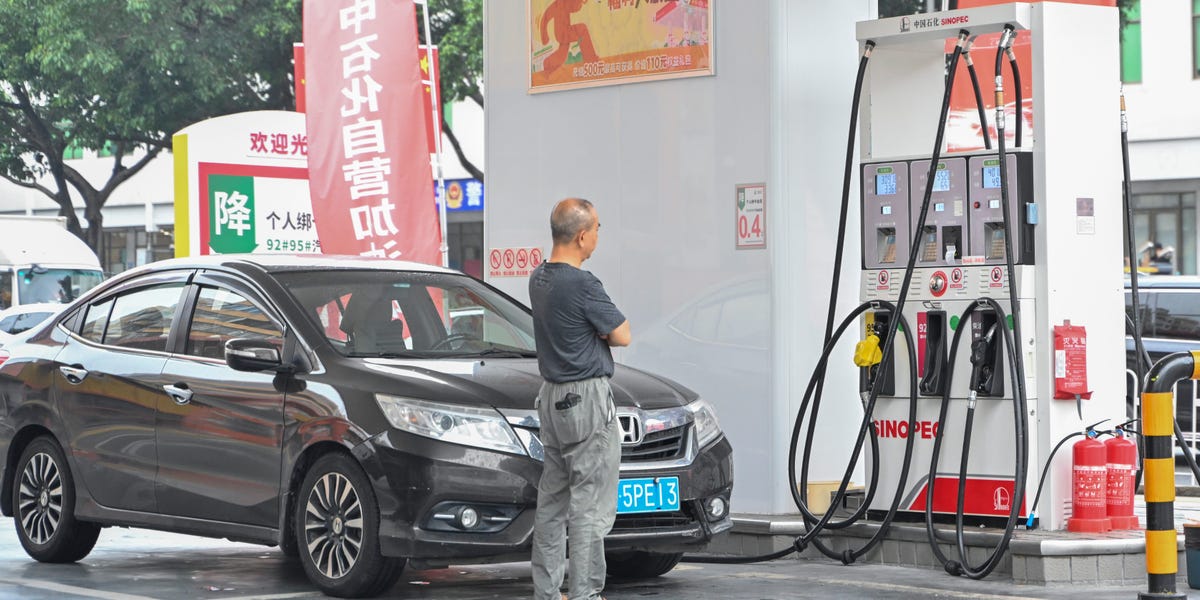
China's sharp pullback in oil imports has helped ease pressure on global crude prices during the Iran war. Chen Jimin/China News Service/VCG/Getty Images Oil is back above $100 a barrel as renewed fighting between the US and Iran raises fears of further supply disruptions in a market already hit by the largest oil supply disruption in history. International benchmark Brent crude breached $100 a barrel on Wednesday for the first time since late July and was trading over $101 on early on Thursday.
US benchmark West Texas Intermediate was around $96. Even so, Brent remains well below its wartime peak of about $126 a barrel in April. One reason the market absorbed the initial shock better than the scale of the disruption might suggest is China.
The world's biggest crude importer slashed its purchases by 40%, or 4.6 million barrels a day, between February and May, significantly pressure on the global oil market, according to the International Energy Agency. Goldman Sachs estimates Brent's fair value — the price suggested by supply, demand, and inventories — would have been $10 to $15 a barrel higher if China had kept its imports steady from March through August, the bank wrote in a report on Monday. "I don't think we can overestimate the extent to which that has been an important balancing factor," David Fyfe, the chief economist at energy and commodities pricing firm Argus, said at the firm's conference in Singapore on Monday.
Rystad Energy, a consultancy, sees that shift as a new role for China in the global oil market. CEO Jarand Rystad called the country "one of the important factors saving the energy system" at the company's Asia summit in Singapore last week. He likened China to a "demand-side OPEC": Instead of controlling how much oil it supplies, China can increasingly help balance the market by changing how much it buys as prices rise and fall.
That flexibility rests on a series of buffers China has built over the years — from oil stockpiles and electric vehicles to alternative fuels and supply routes. Loading up on cheap oil China entered the war with a large oil cushion. China imported about 12 million barrels a day in the second half of 2025, when oil prices were relatively low, and maintained that pace through February, according to the US Energy Information Administration.
China doesn't disclose how much crude it has stored, but Goldman estimates its visible stocks remain above the high level of 1.1 billion barrels. Those stocks have given China room to buy less as prices rose. Goldman said 1.3 million barrels a day of the drop in July imports reflected China's shift from building inventories last year to drawing them down since May.
China's huge refining industry gave it another option. Some refiners that initially scrambled for replacement crude later began selling cargoes back into the market as export curbs, domestic price controls, and consumers cutting back hurt the economics of refining them, according to Rystad Energy. Turning coal into fuel China has another option few big oil importers can match: It can turn its vast coal supplies into products that would otherwise require oil or gas.
That helps explain why China's crude imports have fallen much more sharply than its oil use, Rystad said. Goldman said China's coal-based petrochemical industry, along with electric transportation, has made it easier to use less oil "without much pressure on economic activity. " China is also turning coal into synthetic natural gas — a methane-rich fuel that can be used much like conventional natural gas.
Electrifying transport China's electric-car boom has already weakened its demand for gasoline. Now, electrification is spreading to taxis, public transportation, and heavy trucks. Those investments have made it easier for China to cut oil use when prices rise.
China's progress in electrifying heavy trucks caught Rystad "to some extent by surprise," Rystad Energy's chief economist Claudio Galimberti said at the summit. One in four trucks sold in China last year was electric, according to the International Energy Agency. EVs displaced around 1 million barrels a day of Chinese oil demand in 2025, according to the IEA, which said electric trucks were already making a meaningful contribution.
Energy mix The Iran war has also squeezed supplies of liquefied natural gas from the Gulf, forcing some Asian countries to turn to more coal. China is less exposed, with a power system built around domestic coal and a rapidly growing supply of wind, solar, and nuclear power. China's natural-gas demand fell 4% from March through June from a year earlier, while stronger domestic production helped push LNG imports down 12%, according to the International Energy Agency.
The decline in Chinese imports helped ease pressure on the global gas market. Bypassing chokepoints China depends heavily on foreign oil, but not all of it has to pass through the Strait of Hormuz. Pipelines from Russia and Kazakhstan deliver crude directly to China overland, giving Beijing access to supplies that don't pass through Hormuz.
A separate pipeline from Myanmar provides another route into China, although Middle Eastern oil using it must still pass through Hormuz. Pipelines accounted for about 8% of China's crude imports in 2024, with the other 92% arriving by sea, according to the EIA. Those pipeline flows held steady even as China's seaborne imports plunged during the Hormuz disruption, the agency said.
China is also buying more oil from Russia by sea. Russia has shipped more than 10 million barrels of crude to China through the Arctic's Northern Sea Route this year, Reuters reported last week. Chinese buyers have stepped up purchases of Russian crude as Iranian supplies tightened and concerns persisted over Hormuz, traders told Reuters.
The Arctic volumes are small, but unlike crude shipped from the Persian Gulf, they don't have to pass through Hormuz. China isn't the only reason prices have stayed below their crisis highs. Gulf production had partly recovered, while weaker demand and rising output from the US and other producers have helped narrow the global oil shortfall, Goldman said.
But China's role can work both ways. After cutting purchases when prices surged, it began buying more again as prices eased in July, Galimberti said. "I do believe that China as a swing consumer is a force of stabilization in the market," he said.
Read next Huileng Tan You're currently following this author! Want to unfollow? Unsubscribe via the link in your email.
Huileng Tan is a senior reporter based in Singapore, covering markets, the global economy, commodities, and investing. Her reporting focuses on how shifts in money, demographics, technology, and policy are reshaping businesses, wealth, and everyday life around the world. Since joining Business Insider in 2021, she has covered everything from commodity booms and investor trends to China's economy, the AI trade, and the forces driving global markets.
Before joining Business Insider, she reported for CNBC, Dow Jones, ICIS, and The Wall Street Journal. In 2018 and 2019, she won the Singapore Exchange Orb Awards for Story of the Year – Derivatives for her reporting on the global commodities and derivatives markets. Reach her at htan@businessinsider.com .
Iran oil prices Energy Crisis More Economy
Source: Business Insider